
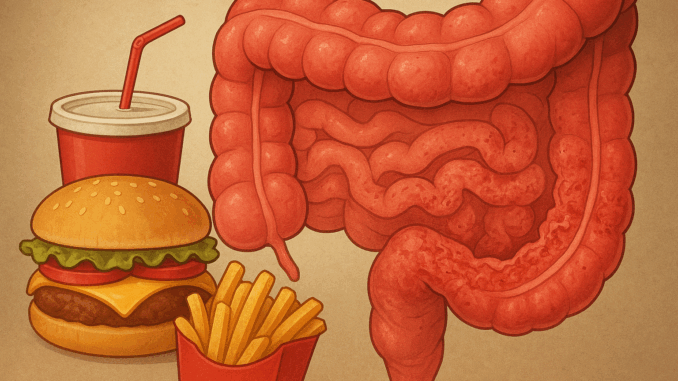
We’ve all heard “you are what you eat,” but it turns out your gut takes that way more literally – and faster – than most of us realize.
Scientists at Melbourne’s WEHI research institute have found something startling: even two days of eating a high-fat diet can start tinkering with your gut’s defenses. No bloating, no bellyache, no obvious signs. Just quiet, microscopic changes that can snowball over time.
Here’s what happened. In a mouse study, researchers saw that levels of a gut-protective protein called IL-22 plunged after only a couple of high-fat meals. IL-22 normally helps prevent inflammation. Without it, the gut’s natural shield weakens, opening the door to trouble later. Chronic inflammatory diseases – like inflammatory bowel disease or even rheumatoid arthritis – don’t show up overnight, but this helps explain where the spark comes from.
Dr. Cyril Seillet, one of the senior researchers, put it plainly:
“Every meal is shaping our gut health, for better or worse. The more saturated fat we eat, the more low-level inflammation builds. It hides for years before surfacing as chronic disease.”
The mice didn’t gain weight or show outward illness. They looked fine. That’s the sneaky part. Under a microscope, though, their gut lining was already stressed.
Another twist? Not all fats behave the same. While saturated fats (think greasy fast food) cut IL-22 production, unsaturated fats – like those in avocados and nuts – actually boosted it. A tiny diet tweak could make a big difference.
Le Xiong, the paper’s first author, called it a “double hit”: saturated fats spark inflammation and disarm your body’s defenses. “It took only two days to see IL-22 levels collapse,” Xiong noted. “That’s fast.”
The good news: the damage wasn’t permanent. When IL-22 levels were restored, the mice’s gut function bounced back. That hints at potential future treatments. But researchers stress that the simplest fix right now is eating more foods that naturally support your gut’s protective barrier.
Occasional indulgence? Probably fine. But if fries and burgers are a daily habit, your gut may be waging a silent war you can’t feel – yet.
This work, done in partnership with Monash University, the Baker Institute, and the University of Melbourne, was funded by Australia’s National Health and Medical Research Council.
Source: Sciencedaily.com