
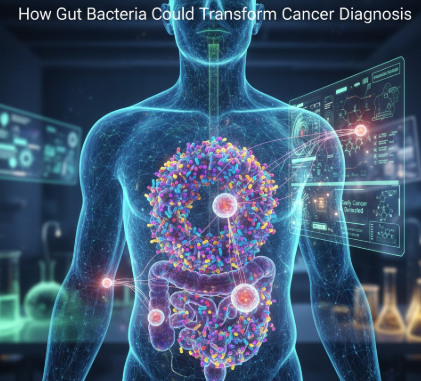
Nobody wants to think about their gut. Not really. We’d rather talk about keto, or that fancy new probiotic yogurt, or anything besides the messy, mysterious, and frankly embarrassing factory churning away in our bellies. Here’s the thing, though. That factory? It’s got something to say. It’s sending up flares. And for years, we’ve been missing the signal.
You’d be crazy to ignore this. Scientists have finally started listening. Not with scopes, not with cameras on a string – but by decoding the secret language of your microbiome. It’s a wild, microscopic world in there, and the tiny creatures throwing the party (or starting a riot) are leaving behind chemical breadcrumbs. These aren’t just clues. They’re a screaming, neon billboard about your health.
And the old way of reading it? It’s brutal.
Forget the Camera Pill. The Real Intel is in the Aftermath.
Let’s be real. The words “endoscopy” or “colonoscopy prep” are enough to make anyone break a cold sweat. They’re effective, sure. They’re also invasive, expensive, and frankly, a whole ordeal. Worse? They can miss stuff. Early whispers of trouble get drowned out until they become shouts – and by then, options start narrowing.
What if you could skip the preamble? What if, instead of sending in the robotic spelunking team, your doctor could just… ask your gut what’s wrong? That’s the seismic shift happening right now. Researchers have been playing detective with poop. No, really. They’re using AI – not the flashy, world-ending kind, but the nerdy, pattern-spotting kind – to sift through mountains of data from people with gut diseases. Gastric cancer. Colorectal cancer. Inflammatory bowel disease. They fed the machine the stories, and it started connecting the dots in ways we never could.
The plot twist? The dots connect across diseases.
Your Gut’s Gossip: When Bacteria Blab About Everything
Think of your gut like a crowded, ancient city. Different neighborhoods, different factions. When gastric cancer starts brewing, it’s like seeing a specific crew take over: the Firmicutes and Bacteroidetes gangs, throwing their weight around, changing the local economy (that’s your metabolites, by the way). They leave behind weird trash, like dihydrouracil and taurine. That’s their signature.
Now, imagine researchers see that same graffiti – the same chemical tags, the same bacterial thugs – somewhere else entirely. Over in Inflammatory Bowel Disease (IBD) territory. It’s not the full picture, but it’s a hint. A massive hint. It means these different gut diseases might be talking to each other, sharing playbooks, or starting from similar points of chaos.
Let’s paint a picture. Say there’s a guy, Mark. He’s 48, a bit stressed, eats on the run. He’s got some bloating, nothing dramatic. Standard tests show zilch. But a biomarker panel, born from this cross-disease research, spots it. It sees the faint metabolic echo of a pattern more common in gastric cancer. It’s not a diagnosis, but it’s a bright red arrow pointing right at Mark, saying “LOOK HERE. NOW.” So they look. Closer, earlier, with purpose. And they find a problem the size of a pinhead, not a plum. That’s the difference between a quick outpatient procedure and a fight for your life.
The Shared Pathways: When Your Body’s Wiring Gets Crossed
This is where it gets mind-bending. For colorectal cancer, the usual suspects are different. Think Fusobacterium and Enterococcus bacteria, leaving behind isoleucine and nicotinamide like calling cards. But sometimes – sometimes those same calling cards show up in the gastric cancer data. It’s like two different crimes, but the getaway car is the same model.
What does that mean? It suggests these diseases, for all their unique horrors, might be hijacking the same rusty, old systems in your body. They’re using the same broken stairwells, the same busted doors. If we can lock those doors? We don’t just stop one burglar. We stop a whole crew.
IBD tells its own story, with Lachnospiraceae bacteria and metabolites like urobilin taking center stage. The kicker? Some of these markers are also tangled up in cancer pathways. It’s all connected. Chronic inflammation from IBD isn’t just an annoyance; it’s lighting a fuse. The biomarkers are showing us the exact path of the spark.
So What Now? From Lab Coats to Your Doctor’s Office
This isn’t just science for a dusty journal. The folks behind this work are thinking bigger. They simulated the whole gut city – how the bacteria grow, how the chemical fluxes change. The difference between a healthy state and a diseased one wasn’t subtle. It was a total system meltdown.
Their big, brilliant idea? Use what we learn from one gut disease to catch another. Train an AI on gastric cancer data and see if it can spot the warning signs for IBD. Turns out, it can. Scary well. This is the blueprint for a universal gut translator. A single, non-invasive test – a blood draw, a stool sample, something simple – that can screen for multiple nightmares at once.
Imagine walking into your physical. You do the usual stuff. But you also give a sample for the “gut panel.” A week later, your doc isn’t just talking cholesterol. She says, “Your biomarkers show a pattern we associate with early inflammatory shifts. Nothing’s wrong yet, but let’s talk diet, stress, and a follow-up in six months to see if we’ve calmed the waters.” That’s proactive. That’s personal. That’s medicine that listens.
The Road Ahead is Messy, Human, and Hopeful
Here’s where we’re at. The team’s got a map. Now they need to prove it works in the real, messy, diverse world. They need bigger studies. They need to turn these biomarkers into actual, brick-and-mortar diagnostic tests. They need to ask the next wild question: if these markers hint at gut problems, what else are they whispering about? Mental health? Autoimmune conditions? The connections are probably there, waiting.
This changes everything. It moves us from reactive to detective. From waiting for the body to break to hearing its first, faint groan. It’s not a magic bullet. It won’t make scopes obsolete tomorrow. But it gives us a new sense. A way to hear what our guts have been trying to tell us all along.
All we had to do was learn how to listen.
So next time you think about that weird, hidden world inside you, don’t just grimace. Think about the whispers. The tiny clues. The armies of microbes and the chemical trails they blaze. Science is finally tuning in. And the story it’s hearing? It just might save your life.
Source: Sciencedaily