
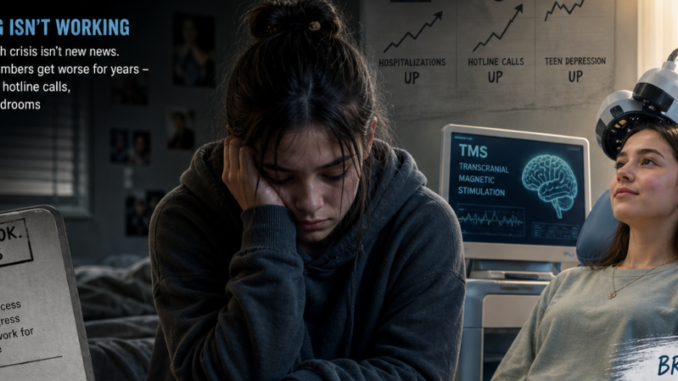
Let’s Be Honest: What We’re Doing Isn’t Working
Look. The teen mental health crisis isn’t new news. We’ve been watching the numbers get worse for years – more hospitalizations, more hotline calls, more kids sitting in their bedrooms unable to get out of bed. And what’s our answer? The same playbook from thirty years ago. Therapy. Pills. Repeat.
I’m not throwing shade at therapists or psychiatrists who prescribe antidepressants. Not at all. Those tools have saved lives. But here’s the thing – they’ve also been around for generations while the crisis keeps getting worse. At some point you have to ask the uncomfortable question: are we missing something? I think we are.
So What Exactly Is TMS, and Why Should You Care?
TMS stands for transcranial magnetic stimulation. And yes, it sounds like something out of a sci-fi film – a device that uses magnetic pulses to stimulate specific parts of your brain. No surgery. No anesthesia. No wires plugged into your skull.
Here’s how it basically works. A coil is placed near your head. It generates a focused magnetic field. That field passes harmlessly through your skull and gently nudges neurons in the targeted region of your brain. That’s it. Most people feel a light tapping sensation. Some get a mild headache afterward. Then they drive home. Their afternoon is fine.
The FDA first cleared TMS for adults with treatment-resistant depression back in 2008. Treatment-resistant – meaning these were people who had already tried multiple medications and they weren’t working. And TMS still helped about 30% of them respond to treatment, with around 15% reaching full remission. Not perfect numbers, sure. But for a population that medicine had essentially run out of options for? Pretty remarkable.
The Numbers That Made My Jaw Drop
Here’s where it gets genuinely wild. The original conventional TMS protocol – five sessions a week for four to six weeks – was a grind. It worked, but the time commitment alone made it inaccessible for a lot of people. Missing weeks of work. Arranging childcare. Rearranging your entire life around a treatment schedule. Then researchers started asking: what if we made it faster?
What followed was a string of studies that, frankly, sound too good to be true until you read the methodology. One accelerated protocol – multiple sessions per day over just five days – achieved a 90% remission rate in an open-label trial. Ninety percent. In adults with treatment-resistant depression. A randomized controlled trial of the same protocol hit 66% remission, and get this – they stopped the trial early because the results were clear enough to push for FDA clearance.
Oh, and the most recent development? A single-day protocol with a 74% remission rate. Let that sink in. One day of treatment. Seventy-four percent of participants reached remission. Now, these are adult studies, and they’re not all randomized controlled trials. Methodology matters. But you’d be crazy to look at those numbers and not feel like something genuinely new is happening in this field.
And the side effects? We’re not talking about the brutal tradeoffs of some psychiatric medications – weight gain, emotional flatness, sexual dysfunction, the chilling black-box warning about increased suicidal thoughts in young people. With TMS, most people walk out of the clinic feeling…pretty normal. Maybe a little tired. Maybe a mild headache. That’s it.
Why Teens Specifically? And Why Now?
Here’s something people don’t talk about enough: antidepressants simply don’t work as well in adolescents as they do in adults. The efficacy is lower. The side effects can hit harder during a developmental period when body image and identity are already fragile. And that black-box warning – the one requiring doctors to warn patients and families about a potential increase in suicidal thoughts – is specifically aimed at young people.
So you’ve got a population in desperate need, a first-line treatment that underperforms, and an escalating crisis. And until March 2024, TMS wasn’t even FDA-cleared for adolescent depression at all. That changed. The clearance came through. Insurance companies started covering it. And now, researchers – including one group at UT Austin – are moving to answer the next obvious question.
A Study Worth Watching
The UT Austin group is running something genuinely different. Most TMS research to date has focused on treatment-resistant patients – people who’ve already been through the medication carousel. This trial is investigating TMS as a first-line treatment for adolescent depression. No previous antidepressants required. In fact, participants stay antidepressant-free throughout.
The trial, listed as NCT06523439, is enrolling adolescents aged 13 to 20. Everyone gets the active treatment – there’s no placebo group in this phase, which is a limitation worth acknowledging. But the approach is sophisticated: every participant gets an MRI first. The TMS pulses are then targeted based on that individual’s unique brain connectivity patterns. No one-size-fits-all targeting. The coil goes where your brain needs it.
Before and after MRIs will let researchers actually see how the treatment changes functional connectivity in the brain. That’s not just clinically useful – it could help us understand why depression happens in the first place.
The lead psychiatrist and neuroscientist behind the study is betting – and it’s a considered, evidence-backed bet – that personalized, accelerated TMS could work for teens the same way it’s worked so impressively in adults. And if the data supports it, this trial could lay the groundwork for a much larger, controlled study.
What a Paradigm Shift Actually Looks Like
We throw that phrase around a lot. “Paradigm shift.” Usually it means “a thing changed a little bit.” But what’s happening with TMS in psychiatry is genuinely different. Think about what conventional treatment looks like for a depressed teenager. Weeks of waiting for a therapist appointment. Months of trying one medication, experiencing side effects, titrating the dose, waiting to see if it works, and then starting over if it doesn’t. All while the teen is failing classes, withdrawing from friends, and suffering through what should be formative years of their life.
Now imagine instead: five days of targeted, personalized brain stimulation based on your individual neurology. Then you’re done. You resume normal life.
I’m not saying TMS is magic. It isn’t a cure. Some people don’t respond. Some need maintenance sessions. The research is still maturing. But the direction of the science is unmistakable – and for adolescents specifically, who deserve better than the current standard of care, that direction is overdue.
What You Can Actually Do Right Now
If you’re a parent watching your teenager struggle, or if you’re an adolescent reading this yourself – you’re not stuck waiting for the field to catch up. The UT Austin trial is actively enrolling. If you or someone you know is between 13 and 20, hasn’t started antidepressants, and is dealing with depression, reaching out to that research team could mean accessing a cutting-edge treatment at no cost, while also contributing to science that could help the next generation of teens.
The mental health system is slow. Research is slow. Insurance approvals are agonizingly slow. But something is genuinely moving here. And the teens who need help right now deserve to know about it.
Interested in the UT Austin adolescent TMS trial? Search for NCT06523439 on clinicaltrials.gov or reach out directly to the study team for eligibility information.