
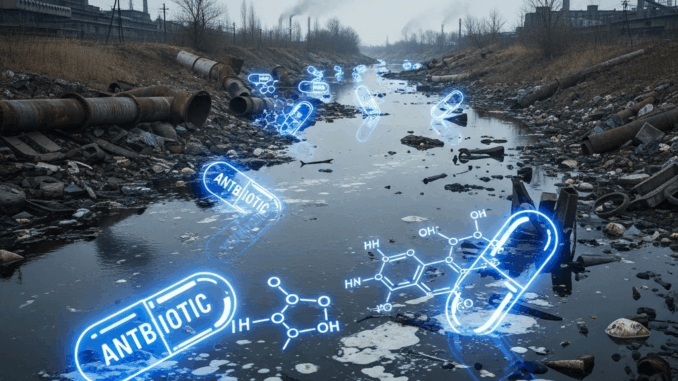
Picture yourself standing by a river. Maybe it’s a calm brook cutting through farmland, or a wide, rushing waterway powering a city. You watch the water flow and think: clean, natural, timeless. But here’s the uncomfortable truth – mixed in with that water are traces of the very medicines we rely on to fight infections.
Yep. Antibiotics. The stuff in your doctor’s prescription pad is quietly slipping into rivers around the globe. And while you won’t see floating capsules bobbing downstream, the invisible residue is enough to cause big problems for fish, bacteria, and ultimately, us.
A new study led by researchers at McGill University – published in PNAS Nexus – is pulling back the curtain on this hidden crisis. And if you think this sounds like one of those abstract, “far-away” environmental problems, think again. Their data shows this is a worldwide issue, touching nearly every major river system on Earth.
A Mountain of Pills, Drifting Downstream
Let’s start with a jaw-dropping number. Every year, humans consume enough antibiotics that about 8,500 tonnes – nearly a third of what we take – ends up in rivers. That’s not a typo. Eight. Thousand. Five. Hundred. Tonnes.
If you’re trying to picture it, that’s the weight of more than 700 double-decker buses. Now imagine grinding them up and dumping them into waterways.
Of course, it doesn’t look like that in real life. What happens is more subtle. People take antibiotics, our bodies use some of it, and the rest is flushed out. Even when wastewater treatment plants step in, they’re not perfect filters. A lot of drug residue still slips through. And in countries where wastewater treatment is limited or nonexistent, even more ends up flowing straight into rivers.
So while the concentration in any one river might be minuscule – almost impossible to detect without sensitive equipment – the constant drip-drip-drip of drug residues is a slow-motion disaster.
A River’s Worst Enemy? The Drugs That Save Us
The McGill team, led by geography researcher Heloisa Ehalt Macedo, explains it this way: antibiotics aren’t toxic like mercury or pesticides. The problem is subtler, sneakier. Over time, low levels of antibiotics in rivers mess with aquatic life. Fish exposed to these residues can experience changes in growth and reproduction.
But the bigger, scarier issue? Superbugs.
Those trace amounts of antibiotics floating in rivers give bacteria endless “practice” at resisting them. And when bacteria learn resistance in rivers, they don’t stay there. They spread – through food, through animals, through human contact. It’s one more accelerant in the already terrifying race against antibiotic-resistant infections.
The Science Behind the Alarming Map
The McGill team didn’t just point at a few polluted rivers and declare a crisis. They built a global model – and then stress-tested it against actual water samples from nearly 900 river sites worldwide.
What they found was sobering.
- Amoxicillin, the go-to antibiotic prescribed for everything from ear infections to strep throat, showed up most frequently and at the riskiest levels.
- Hotspots were clustered in Southeast Asia, where soaring antibiotic use collides with underdeveloped wastewater treatment systems.
- Even rivers far from urban centers weren’t immune – traces of antibiotics turned up in systems around the world, highlighting how widespread the problem really is.
As co-author Bernhard Lehner, a hydrology professor, put it: “We’re seeing unintended side effects, and we need to get smart about managing them.”
That’s scientist-speak for: this problem is real, and it’s not going away by itself.
The Shocking Part: This Is Just Human Use
Here’s the kicker. The study only tracked antibiotics from human consumption.
That means all the doses we take at home, in hospitals, or at clinics. What’s missing? The massive amount of antibiotics used in livestock farming and the wastewater discharged from pharmaceutical factories. Both are known to be major contributors to antibiotic pollution.
In other words, the 8,500 tonnes figure? That’s a baseline problem. Add in animal agriculture and industrial waste, and the true scale is probably much, much worse.
Environmental engineering professor Jim Nicell, another co-author, put it bluntly: “What we found from human consumption alone is already a big deal. Add in those other sources, and it’s probably way worse.”
So, What Do We Do About It?
The researchers aren’t calling for a ban on antibiotics. That would be absurd. Antibiotics are some of the most important drugs in human history – global health heroes that have saved millions of lives.
The issue isn’t the medicine itself, but how we manage it once it leaves our bodies.
Here’s what the team suggests:
- Better Monitoring: We need ongoing, large-scale river monitoring to keep tabs on contamination, especially in the high-risk zones their model flagged.
- Improved Wastewater Treatment: Many treatment plants weren’t designed to catch pharmaceuticals. Upgrading systems could make a huge difference.
- Responsible Use: Doctors, patients, and even farmers need to treat antibiotics like the precious resource they are. Overprescribing and misuse fuel resistance and pollution alike.
These steps aren’t easy, but they’re critical if we want to keep antibiotics working for the generations to come.
The Human Side of the Story
It’s tempting to read about a problem like this and think, “Well, that’s happening somewhere else.” But rivers don’t respect borders. They flow, they merge, they carry whatever’s in them downstream.
That means the antibiotics used in one community can affect ecosystems and people far away.
Imagine fishing in a river that looks pristine, only to realize invisible residues are reshaping its entire ecosystem. Or swimming in a lake that seems safe, while antibiotic-resistant bacteria quietly multiply in the background.
The study is a reminder that environmental health and human health aren’t separate. They’re tied together — literally, by the rivers that weave through our landscapes.
A Wake-Up Call We Can’t Ignore
Let’s be real: pollution stories are a dime a dozen. We’ve heard about plastics, pesticides, oil spills. But the antibiotic crisis is different. It’s not just about what’s happening to the environment. It’s about undermining the very medicine chest we all rely on when we’re sick.
We don’t get infinite shots at beating infections. If antibiotics lose their power, simple cuts, routine surgeries, or common illnesses could once again turn deadly.
That’s why this study is such a big deal. It’s not just another environmental paper gathering dust in a journal. It’s a flashing red warning light: our rivers are quietly helping train the next generation of superbugs.
And unless we act — smarter prescribing, better wastewater systems, and global cooperation — the water that gives life could also help fuel the spread of diseases we can no longer fight.
Final Thought
So next time you’re standing by a river, take a second look. It’s not just carrying water. It’s carrying the choices we’ve made as a society – the medicines we take, the systems we’ve built (or failed to build), and the consequences we’ve ignored.
The McGill team’s message is clear: if we want safe rivers and effective antibiotics, we can’t afford to treat this as tomorrow’s problem. The clock’s already ticking.
source: sciencedaily